About Course
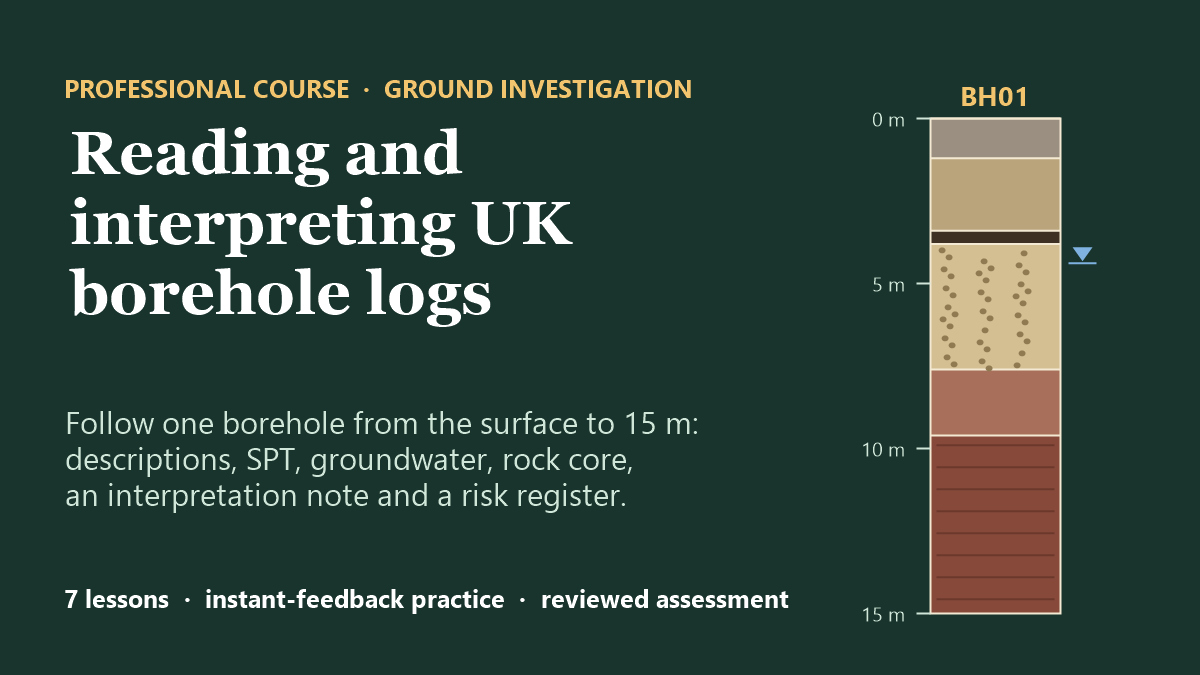
Follow one borehole log, BH101, from the header at the top to the remarks at the foot. Learn what every code, test and symbol means, extract the parameters you need, review the information, and use the log as a basis for your design.
What you will be able to do
- Read a borehole log you have never seen before, from the header to the last remark.
- Explain what each sample code, test result and description tells you about the ground.
- Pull the depths, levels, test results and water levels into a table for design.
- Review a log and say what it does not tell you.
Who it is for
Graduates, early-career engineers, and engineers getting to know UK investigation records.
Basic arithmetic and a first understanding of soil and rock will help. You only need a browser and an ordinary document or spreadsheet program.
I have prepared this as a practical learning course. You will build an extraction table from a borehole log and answer an assessment on a second log. Completing it does not guarantee a job, professional accreditation or independent design competence.
Your £75 course package
Nine self-paced lessons that follow one fictional log, BH101, downloadable A4 copies of every log, 38 practice questions with immediate feedback, and one BH201 final assessment personally reviewed by me.
Submit your first final assessment within three calendar months of purchase. I will provide feedback within 10 working days after receiving complete, readable work. One resubmission is included within 30 calendar days of feedback. Lesson access continues while I provide this course on the platform; the assessment deadline still applies.
What does passing require?
At least 70 out of 100. I review every final submission. Unclear or unreadable answers may need clarification before I confirm a result.
Will I get a job after completing this?
No job is guaranteed. The course gives you a defined training task and work you can discuss honestly: reading a borehole log, extracting ground data and reviewing what the log does not tell you. Employers also consider qualifications, wider experience and the requirements of each role.
Is the certificate accredited?
I issue a certificate of assessed completion after you meet the assessment requirements. No external accreditation or regulated qualification is claimed. The certificate records the course, assessed work, provider, issue date and unique identifier.
Do I mark my own assessment?
No. Practice checks give immediate automatic feedback. I personally review the final assessment and return feedback. Completing practice questions alone does not trigger a certificate.
What will I upload?
Your answers to the ten BH201 questions in one document, with your extraction table as a table or a spreadsheet. Use only the supplied fictional BH201 log. Upload up to four PDF, DOCX, XLSX or CSV files, each no larger than 10 MB. Do not upload confidential employer or client material.
What if I do not pass first time?
I explain the evidence that needs correction. One resubmission is included within 30 days of feedback. A resubmission is reviewed against the same stated requirements; a pass is not guaranteed.
Can I use this as employment experience?
Describe it as assessed training or a training project. Do not present the fictional project as paid work or a real client commission.
Course Content
Welcome
Welcome
Lesson 1: What a borehole log is
Lesson 2: The header
Lesson 3: The columns, and what was installed
Lesson 4: The top 1.20 m: concrete, made ground and the first samples
Lesson 5: 1.10 to 3.40 m: the alluvium, the first SPT and U1
Lesson 6: 3.40 to 12.45 m: gravel, water strikes, sand and clay
Lesson 7: The foot of the log: remarks, methods and status
Lesson 8: Water monitoring, and a log with rock core
Lesson 9: Using the log as a basis for design
Final assessment: BH201 review
Student Ratings & Reviews