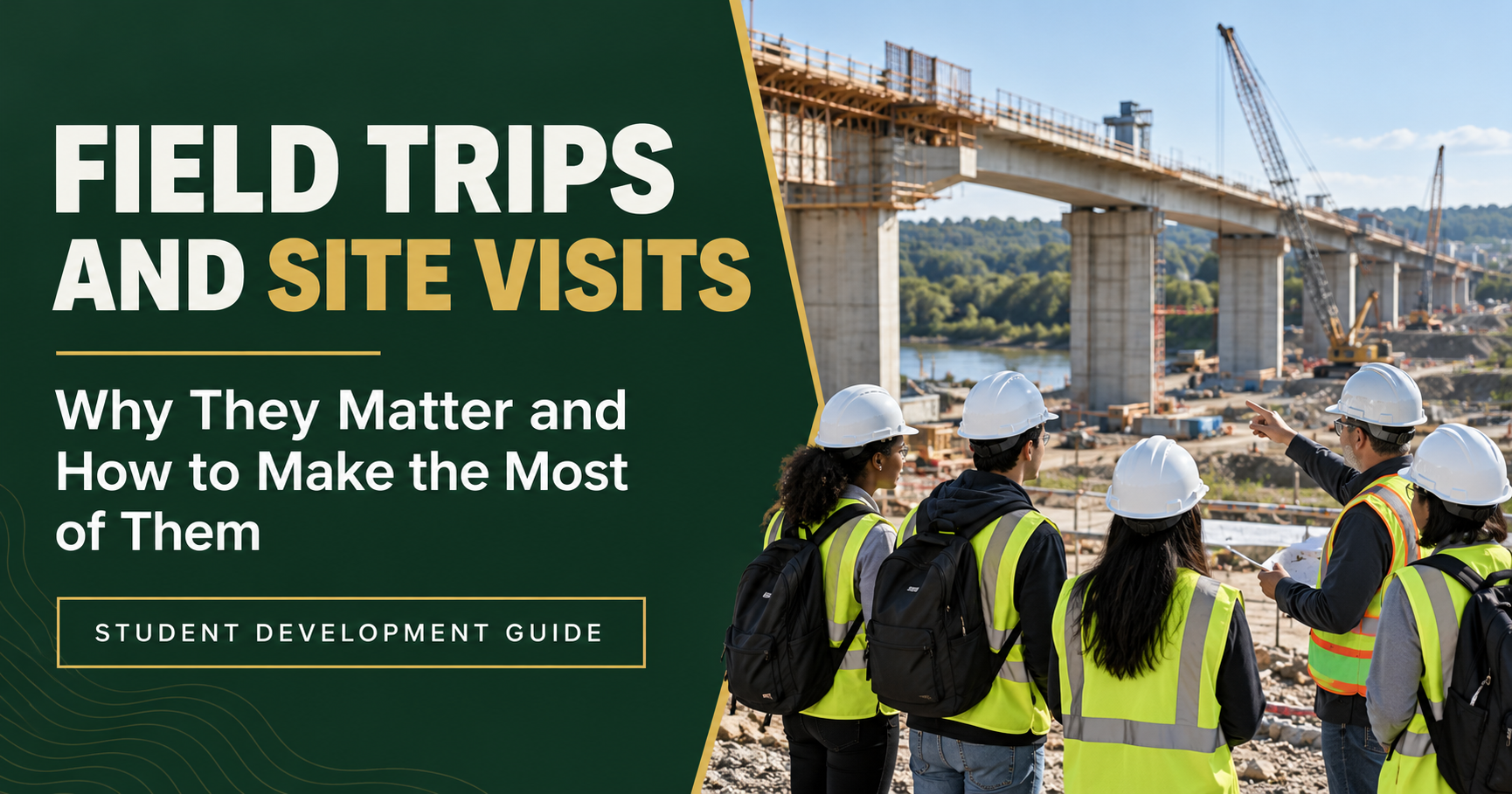
Field trips and site visits are sometimes treated as a pleasant break from lectures. If they carry no marks, students may decide they are not important. Others believe they should wait until their final year, when they understand more.
That misses the real value. A site visit is an opportunity to connect what you learn with how decisions are made in practice. It can help you understand your course, discover careers, recognise problems worth investigating and build confidence in professional settings.
Why field trips and site visits matter
They make learning real
A lecture explains principles. A visit shows how those principles are applied when safety, cost, time, people, regulations and site conditions all affect the decision.
They widen your career awareness
You see roles, responsibilities and routes into industry that may never appear clearly in a module description.
They reveal research questions
Repeated difficulties, imperfect methods and unresolved problems can become the starting point for a project, dissertation or future research idea.
They develop professional judgement
You begin to see that good practice is not only technical. It also involves communication, ethics, sustainability, teamwork and sensible compromise.
How to make the most of the visit
Prepare with a purpose
Read about the organisation, the project and the type of work you are likely to see. Check whether the organisation offers placements, internships, graduate roles or student programmes. Then write down one thing you want to understand and three questions you want to ask.
Also confirm the practical details: suitable clothing, safety requirements, transport, photography rules and what you are allowed to bring.
Look beyond what is immediately visible
Do not focus only on large equipment or impressive structures. Observe the decisions behind the work. Ask:
- What are you doing here, and why are you using this method?
- How else could this work be done? What other methods are available?
- What standards or codes do you most often follow here?
- Which agencies or regulatory bodies oversee this work or require you to comply with their rules?
- How does your work contribute to sustainability?
- What do you look for when employing graduates?
- Do you offer job-shadowing opportunities so students can learn more about the work?
- Are placement or internship opportunities available?
- Do you have data or practical problems that students could use for research projects?
Listen carefully and take brief notes. Respect safety instructions, confidentiality and restrictions on photography or recording.
Turn the experience into something useful
Within a day or two, record what became clearer, what surprised you and what you want to investigate further. Connect the experience to a module, assignment, research idea or career goal.
If someone gave you useful guidance, send a short message of appreciation. Mention one specific thing you learned. A thoughtful follow-up is more valuable than collecting names and never contacting anyone again.
What should you leave with?
A useful visit should give you more than photographs. Try to leave with:
- one concept that now makes more sense;
- one career role you understand better;
- one problem or research question worth exploring;
- one new professional connection, where appropriate; and
- one action you will take next.
Common pitfalls to avoid
Treating it only as a social day
Enjoy the experience, but remember why you are there.
Arriving without preparation
Without context, it is difficult to recognise what is important.
Asking only about jobs
First show genuine interest in the work, the problems and the people involved.
Ignoring professional boundaries
Do not take photographs or share information without permission.
Recording nothing
Useful details disappear quickly. Write down your learning while it is still fresh.
Failing to follow up
A visit becomes more valuable when reflection leads to action.
A word of encouragement
Year 1 is not too early to attend a field trip or site visit. You do not need to understand everything before you go. Early visits can help you see why your modules matter, become familiar with professional language and make better choices about the areas you want to explore.
You also do not need to ask the most advanced question in the room. A simple, thoughtful question based on genuine curiosity is enough. Each visit adds another layer to your understanding.
Not every visit will lead directly to a job or research opportunity. That does not make it a wasted experience. Sometimes the greatest value is clarity about what interests you, what does not and what you need to learn next.
Do not just attend. Prepare, observe, ask, reflect and follow up.
Frequently asked questions
Is Year 1 too early for a field trip or site visit?
No. Year 1 is an excellent time to begin. You may not understand every technical detail, but the visit can give meaning to your early modules and help you recognise possible career directions.
Is a visit useful if it does not contribute to my grades?
Yes. It can strengthen your understanding, professional awareness and examples for future applications and interviews.
What if the visit does not appear directly related to my course?
Look for transferable lessons in project planning, teamwork, communication, safety, sustainability, data, decision-making and problem solving.
What questions should I ask?
Ask why the work is being done in a particular way, what other methods are possible, which standards and regulators apply, how sustainability is considered, what employers seek in graduates and whether shadowing, placements or research data are available.
Can a site visit help me develop a research topic?
Yes. Pay attention to repeated problems, limitations in current methods and questions that do not yet have clear answers.
Should I contact people I meet afterwards?
Yes, where appropriate. Keep the message brief, thank them and mention something specific you learned. Do not begin by asking for a job.
Studying civil engineering?
My Civil Engineering Student Portfolio helps you understand what to focus on at each stage of your degree and how to prepare for academic and professional opportunities.
Explore the Student PortfolioRelated guide: What Civil Engineering Students Should Focus on at Every Stage.

Damilola Akinniyi
Damilola is a geotechnical engineer, educator and researcher who makes engineering and research easier to understand and apply. His work brings together soil mechanics, practical learning, mentorship and career development.
Useful lessons, resources and opportunities
Receive occasional engineering, research and career guidance, plus new resources and early access to free courses.
Join the Email List →